

HELPFUL TIPS - HOW TO DO IT'S - IDEAS PAGE
THE NEXT 12 PAGES CONTAIN A WEALTH OF PROP INFORMATION
from the Bolly Book
which has more information then you probably wanted to know,
all kidding aside if there is something you need to know about props go to this site.
PROPS FOR LARGE R/C SCALE MODELS
The Bolly GRE propellers are especially suited to the large engine use. The extra strength make them much more economical than wood (at any price), and much safer than nylon types which are prone to stretching to destruction at these sizes. The extra weight of a composite prop (compared to wood) often helps the idle characteristics of an engine.
Our first large prop was a 20 x 10 in 1979 when even wooden 20 x 10 were rare.
For large models, props size is often determined by noise, ie, on some flying fields a 18 x 10 may be regarded as too large on a ST 3000, in other areas a 19 x 10 may be regarded as too small. The choice is yours. As a rule the 3 and 4 bladed props make a good choice for noise reduction.
Avoid using tip speeds in excess of 400 MPH if noise is of concern, although 450 MPH tip speed is common in areas of low noise sensitivity.
400MPH tip speed @ 22" = 6 100 max. RPM
20" = 6 800 max. RPM
18" = 7 500 max. RPM
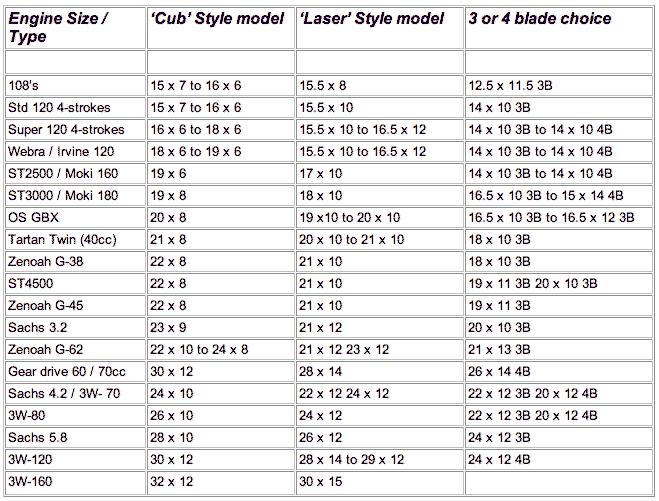
The range is expanding. It is easiest to list the propellers and the engines commonly used. It is our aim to manufacture prop sizes 18" to 30"in diameter, at a pitch of 10, 12 and 14" before mid1997. At the time of printing this book, we can only list many of these newer sizes as NYA.
Please remember, large slow flying models (i.e. Piper Cub, etc) will need more diameter and less pitch.
Selecting the correct propeller is a little like selecting the
correct gear ratio for motor vehicles. For slow flying ,high drag
models (i.e. a Piper Cub)select a higher diameter / lower pitch
prop for it’s ‘pulling’ ability. The reverse
is true for faster type models (ie, Laser, etc), use a smaller
diameter / higher pitch propeller.
Engine Size / Type ‘Cub’ Style
model ‘Laser’ Style
model
PAGE 1 of 12